Agiou Vasileiou 19, Nea Ionia +30 2111821051



The New Entry/Exit System (EES) in Europe: Everything You Need to Know

Post date
02/04/2026
EES Europe: Why You Need to Arrive 2.5 Hours Early at the Airport. The way we travel to Europe is undergoing a major transformation. With the introduction of the Entry/Exit System (EES), border procedures are being modernized across the continent. Although the system applies to specific categories of travelers, its implementation affects overall airport operations.
Staying informed is key to ensuring a smooth and stress-free travel experience.
What is the EES and who is it for?
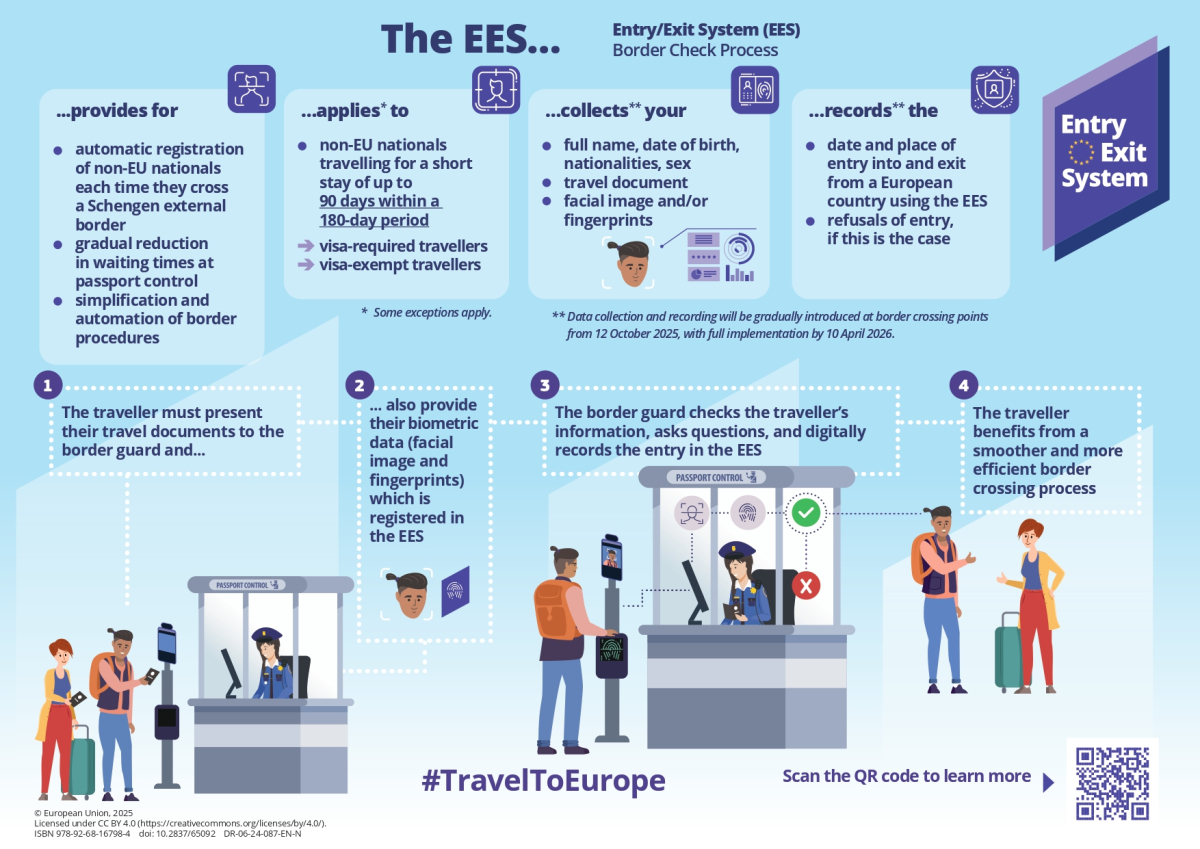
The EES is a new, automated digital system that registers non-EU nationals every time they cross the external borders of the 29 Schengen Area countries. This system replaces manual passport stamping with an electronic database.
Who is NOT affected (Exemptions)?
It is crucial to clarify that the system DOES NOT apply to:
- Greek citizens and nationals of other EU countries, as well as Iceland, Liechtenstein, Norway, and Switzerland.
- Holders of residence permits in Greece or any other EU country.
- Holders of long-stay visas.
- Nationals of Andorra, Monaco, San Marino, and Vatican City.
Who must be registered?
It applies exclusively to non-EU nationals (e.g., travelers from the USA, UK, Australia, Canada, etc.) traveling for a short stay of up to 90 days within a 180-day period, regardless of whether they require a visa or not.Children under 12 are exempt from fingerprinting, but a facial photo is still required for everyone.
Examples: How the system works
- Example 1: Short visit
A traveler from Canada visits Greece for 10 days. Their entry and exit are automatically recorded in the system.
- Example 2: Overstay
A traveler stays 100 days instead of the permitted 90. The system automatically detects the extra days.
- Example 3: Frequent traveler
A third-country national who travels to Europe often and has already registered in the system crosses the border faster on subsequent visits.
Timeline and Process: What changes for Arrivals and Departures
The progressive rollout of the system began in late 2025 and is continuously expanding to achieve full operational capacity across all external border crossing points. As the name suggests, registration is mandatory at every crossing:
- Upon Arrival (Entry): Manual passport stamps are replaced by digital records. During the initial registration, biometric data (facial image and fingerprints) will be collected.
- Upon Departure (Exit): Travelers will be digitally checked again when leaving the airport. The system automatically calculates whether the stay remained within the legal 90-day limit.
Instructions to avoid airport delays
Even though Greek and EU citizens do not need to register in the system, the new biometric procedure for other passengers is time-consuming and may lead to longer queues at passport control points, affecting all travelers indirectly, regardless of nationality.
To avoid unforeseen situations, Athens International Airport (AIA) and relevant authorities recommend:
- Airport Arrival: Arrive at the airport at least 2 ½ hours before your scheduled departure time.
- Timely Processing: Complete your check-in and security screening early to allow sufficient time for passport control.
- Warning: Late arrival at the departure gate due to these checks may lead to a denial of boarding.
What about cruise passengers?
On cruise itineraries with a same-day stop at a Greek port, passengers are generally not subject to full border control when disembarking, provided the cruise begins and ends outside the Schengen Area. The exact procedure depends on the itinerary and the status of the departure and arrival ports. If a cruise begins or ends at a port within the Schengen Area, standard EES registration and checks apply as normal.
Why is this information important?
Providing accurate information is essential to avoid confusion and complaints. Many travelers are actively seeking clarity on these new rules, and proper preparation prevents negative experiences at the border.

Frequently Asked Questions about EES
- What is the EES?
A digital registration system at the EU's external borders for non-EU nationals only. It replaces the passport stamp with a facial photo and fingerprints, captured once at first crossing.
- When did the EES start?
Rollout began on October 12, 2025, and the system has been fully operational at every border crossing point since April 2026.
- Who is affected, and who isn't?
It applies to non-EU nationals staying up to 90 days within any 180-day period (e.g. travelers from the US, UK, Canada, Australia). It does not apply to EU citizens or to holders of a residence permit or long-stay visa.
- How are coach tour groups affected?
Delays occur mainly on cross-border routes carrying non-EU passport holders (e.g. Greece–Albania, Greece–Turkey), especially the first time a passenger registers. Routes that stay entirely within the Schengen Area (e.g. Athens–Rome) see no new checks at all
- Do travelers need to prepare anything in advance?
No. Registration happens automatically at the border on first crossing — there's nothing to arrange beforehand.
- Is personal data secure?
Biometric data is protected under GDPR and retained for 3 years, or 5 years if an overstay is recorded.
We want your journey to Greece to be as seamless as possible. Stay informed, arrive early, and focus on the beautiful experiences awaiting you!
Sources:
https://travel-europe.europa.eu/el/ees
Photos: European Union, 2025 Licensed under CC BY 4.0 (https://creativecommons.org/licenses/by/4.0/)., RF Gettyimages
Gallery
